

-
Lab Guide
- Introduction
- Lab Principles
- Structure & Organization
- Meetings
- Recruiting
- Working Together in the Lab
- Publishing Results & Software
- Use of Data in the Research
- Knowledge Transfer
- Working with Externals & Students
- Reporting, Monitoring & Evaluation
- Budget & Accounting
- Ethics & Compliance
- Diversity, Equity & Inclusion
-
Branding and assets
-
Useful templates
Structure & Organization
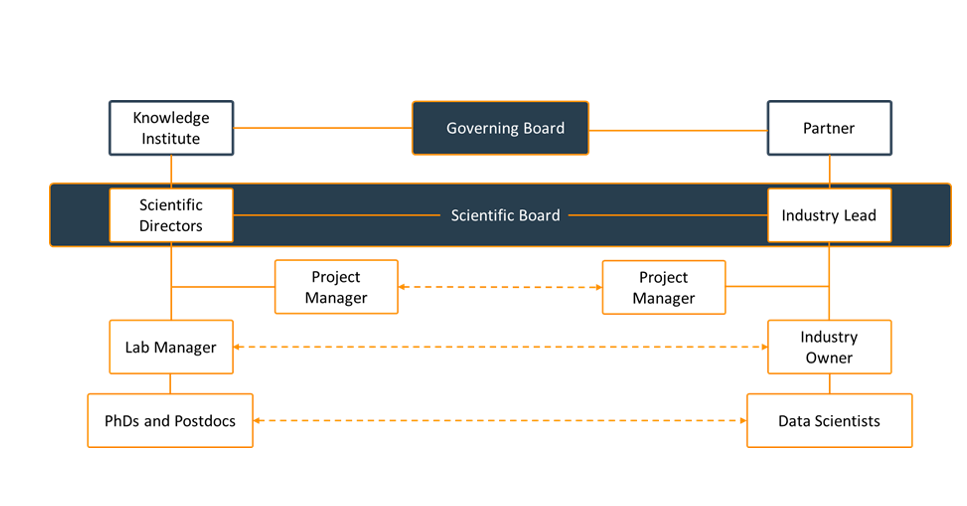 In general, labs in ROBUST will be structured following the above ICAI lab model. This structure may be adjusted where needed. The lab agreements need to be followed for governance. A Governing Board, Scientific Board, plus Lab Manager and PhD students all play important roles in the lab. These are discussed below.
Each lab will establish a Governing Board composed of one representative from each of the partners involved in the lab.
The Governing Board shall be responsible for amongst others:
- Approving the project plan and the annual update of the same;
- Approving annual budgets and budget changes;
- Reviewing the yearly report;
- Discussing and evaluating on potential extensions of the lab beyond the first five years, and the initial 5 PhD students;
- Reviewing progress in the research;
- Reviewing the status of any IP;
- Recommending the addition of any third party as a party to the lab agreement;
- Making a proposal for the appointment or discharge of the director(s) of the lab, and discussing any changes to personnel;
- Ensuring the lab operates within the terms of the lab agreement.
The Governing Board is required to meet twice a year. After each meeting, minutes will be distributed and approved in the following meeting. Besides the Scientific Board directors and Governing Board directors, a secretary may also be appointed to the board. This position is usually filled by a business partner in the lead knowledge institute.
At the Governing Board meetings, the Scientific Board is present to explain the progress, planning, and the decisions that need to be made. The input of the Scientific Board is in most cases needed for the Governing Board members to make decisions. Often the lab manager is also invited to present a scientific progress update on the lab. This is usually done via a presentation. Slides should include the impact the research has had for the partners, and this can be measured in terms of papers published, patents filed, workshops, events etc.
The following documents are prepared for Governing Board meetings:
- Agenda for the meeting (see template)
- Minutes of the last meeting
- Quarterly reports that have been prepared since the last meeting
- Yearly overview of the progress
- Updated project plan (once a year, if necessary)
The Scientific Board will be composed of a minimum of two scientific directors, appointed by the Governing Board, with additional appointments possible if more academic partners are involved in the lab. The industry partner may also be a part of the Scientific Board, to provide input on the research directions of the lab and to review any publications. The industry lead may play this role.
Two scientific directors are required for consultation, and to make sure the lab does not depend on only one person. Also, the experience of a more senior person may be transferred to a less experienced colleague.
The scientific directors are responsible for:
- Proposing the annual update of the project plan to the Governing Board;
- Preparing and presenting the quarterly reports to the Governing Board;
- Preparing the meetings of the Governing Board, including needed decisions;
- Coordinating the publication of any research papers, inter alia ensuring the appropriate prior consultation with the partner;
- Hiring the PhD students;
- Ensuring the quality of the research.
It is expected that a regular meeting between the scientific directors, lab manager, and secretary will take place in order to:
- Discuss administrative items and processes outlined in the lab contract (e.g., IP arrangements, software etc.);
- Discuss all registers (e.g., collaboration with externals, publications);
- Discuss possible issues with the industry partner;
- Document progress in the lab.
As the lab gets started, it is recommended that the directors meet with the lab manager every other week. As the lab matures, the frequency of the meetings may be adjusted to approximately monthly.
The industry lead is the main contact point between the industry partner and the scientific directors, and is responsible for the embedding of the PhD students in the industry organization. Usually this person is in direct contact with the scientific directors, and may also play a role in the Scientific Board, as described above.
The industry lead meets monthly with the scientific directors and lab manager to discuss progress in the research.
The lab manager role is fulfilled by an academic at the level of assistant professor. The lab manager is responsible for day-to-day supervision of the PhD students, meeting with each student weekly, and maintaining close contact with the scientific directors. The lab manager has the following responsibilities:
- Guiding and supervising PhD students, and meeting with them weekly;
- Serving as main point of contact between the lab and its industry partner(s);
- Producing quarterly reports by scheduled deadlines;
- Maintaining registers and overviews.
A separate and more detailed information packet for lab managers is under construction and will be released upon completion.
To manage administrative processes in the lab, a project manager may be assigned as a counter-partner to the lab manager, maintaining contact and keeping oversight of all legal and financial aspects of the lab, including:
- Producing the annual overview;
- Keeping a general overview of project milestones, and ensuring adherence to agreed-upon schedules;
- Managing any changes to contracts, e.g., increasing the length of the contract.
It may be the case that the industry lead may appoint an industry owner to manage the day-to-day administration of the project, including supervision of the data scientists. This role is roughly equivalent to that played by a lab manager on the academic side. If both are present in the structure of the lab then they are encouraged to work together and keep in close communication.
Each PhD student needs a direct contact person on the industry side. This is usually an industry expert with a technical background (e.g., a ML expert or data scientist) able to translate the work of the PhD student into aspects relevant for the partner. This data scientist will serve as the main point of contact for the student at the industry partner, and will work directly with the student on cases, giving access to datasets, and sharing their insights. Please note that it may be the case that each work package has its own industry contact person, or multiple work packages could have the same industry contact person.
Each student is guided by an academic supervisor who will ensure the following:
- At the beginning of their studies, PhD students must understand that they are working in collaboration with an external partner organization that will have certain restrictions pertaining to IP and publication. These are specified in the lab agreement between the lab and its industry partner(s). It is the supervisor’s responsibility to ensure that the student understands and abides by these requirements.
- Every student will work in close collaboration with the industry partner. The case relevant to the partner needs to be determined at the start of their trajectory in collaboration with the academic supervisor and industry partner. A time period (e.g., 6-9 months) will be specified in which the student will focus on this case. Once it is rounded off with a publication, a follow-up case (and suitable time period) will be determined.
- Students are to remain focused on their PhD trajectory and should not be burdened with too many additional tasks in the partner organization.
- Research will be executed according to the description in the work package. The researchers and partners will have regular meetings to align on the progress and direction of the research. Research direction may develop and change over time; we suggest using a project canvas to have a periodic check-in with the partner on the direction of the next phase in the PhD trajectory.
- Regular weekly meetings will take place between the student and their supervisor and between the student and their industry supervisor; a meeting with all three parties should take place monthly.
The student is also overseen by an industry supervisor:
- The PhD student will work on a regular basis at the premises of the industry partner. This can be on average one day per week, depending on distance, and at what point the student stands in their PhD trajectory. At the premises, the students meet with their industry supervisor to discuss progress and cases, do experiments, share knowledge, etc. Knowledge is developed and transferred in close collaboration with the industry partner, thus time spent on site is critically important.
- Working at the premises does NOT mean that the student works for the company. All the work that the student undertakes at the premises is work toward the PhD trajectory. It is not the intention that students do engineering work or additional tasks for the company next to their PhD trajectory.
- Students in a lab (either on the academic or industry side) are encouraged to organize gatherings and meet with each other regularly. Examples of such gatherings can include: reading groups, seminars, lunch meetings, presenting work to each other etc.