The Launch of the First ICAI Unit – IMAGINE
Since 2018, ICAI has been at the forefront of building impactful and sustainable collaborations between universities, industry, and the public sector. While the existing ICAI labs have become a nationwide standard for research-driven collaboration, there is a significant increase in the need to create even more direct impact by translating research outcomes into applicable and adoptable AI solutions. Inspired by the way that University Medical Centers and some other organizations have started to organize themselves to optimize for impact, we have established a new format: the ICAI Unit.
An ICAI Unit includes the same key elements as an ICAI lab – PhD students working on co-owned research questions – but on a much larger scale. While the labs typically host 5 to 20 PhD students for five years, a unit involves 40 or more researchers and operates for an indefinite period of time. This format is closely tied to an organization’s ongoing core innovation pipeline and facilitates every aspect of implementation, from prototyping and usability studies to navigating regulation and organizing professional education.
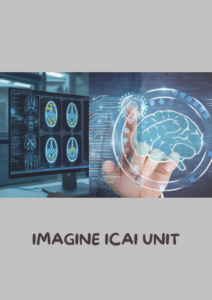
The first ever ICAI Unit launched is called IMAGINE (Open Innovation Lab for the development and implementation of Image-guided interventions), and it is led by Prof. Dr. Nico van den Berg at University Medical Center (UMC) Utrecht. The mission of the unit is using AI to make image-guided treatments better, faster, and more accessible for everyone, rooted in the UN Sustainable Development Goals for improved health and reduced inequalities. To manage this ambitious program, IMAGINE uses a three-tier governance structure that connects strategic vision with daily operations:
- Strategic Level: The General Assembly safeguards the partnership’s boundary conditions, while the Steering Committee (chaired by Prof. Dr. Nico van den Berg, and Innovation Officer Dr. Maarten van Kouwen) identifies trends and maintains the strategic course.
- Tactical Level: The Strategic Portfolio Team, the IMAGINE LTP program committee, and the User Committee manage the innovation process and content.
- Operational Level: Individual Work Packages execute the scientific work and innovations.
This structured approach allows IMAGINE to execute its scientific research through specialized work packages that target different stages of the research-innovation chain. Compared to the lab, the key distinctive factor and added benefit of the unit is focused on a long-term mission to improve global health and reduce inequalities, its work extends far beyond the typical five-year research cycle. Achieving a sustainable social benefit in a highly regulated sector such as the medical one requires a deep commitment to the importance of validation through usability studies and clinical evaluations, ensuring that AI solutions actually work for patients and staff in real-world conditions. Furthermore, to move past theoretical research and toward actual adoption, the unit manages all necessary ethical and legal checks, including data-sharing protocols and compliance with institutional requirements. This comprehensive understanding of how actual implementation is done allows IMAGINE to differentiate itself from a regular ICAI lab, transforming AI research into a socially responsible tool that remains accessible and effective for everyone over the long term.
The unit functions as a multi-disciplinary public-private partnership designed to unite critical stakeholders (including hospitals, universities, and research institutes) to accelerate innovation in image-guided interventions. Established at the UMC Utrecht, IMAGINE brings together academic leaders such as TU Eindhoven, Radboud UMC, and Utrecht University with industrial and societal partners like NKI, Lygature, Catharina Hospital, Elekta, Philips. To ensure that these innovations translate into professional practice, the partnership also involves Universities of Applied Sciences, such as Fontys, to directly apply new research into the clinical curriculum. This unit also has a dedicated space at UMC Utrecht where its industrial partners like Philips and Elekta can work alongside clinicians and researchers. This eliminates the “splendid isolation” of traditional research, ensuring that technical experts are physically present in the clinic and can understand better the real-world workflows.
In an interview conducted with Prof. Dr. Nico van den Berg and Dr. Maarten van Kouwen, they explained that the long-term nature of the unit is essential because in the medical technological and medicine field, it takes time to have an impact as it is a highly regulated sector. They also mentioned that technology has a direct human benefit, emphasizing that AI enables healthcare teams to finish their work faster and more accurately, which reduces the strain on patients as well as the workload for staff.
IMAGINE is more than a project. It is a community of over 90 specialized researchers, including 60 PhDs and 15 postdocs. They are looking beyond the math that is behind the Machine Learning or Computer Vision; the researchers of this unit are focused on making AI responsible and explainable so that doctors can trust the results. Dr. Maarten van Kouwen emphasizes that practical approaches to AI innovation come from being present in the hospitals and carefully listening to clinicians; from actually understanding the workflow and the challenges in the clinic.
The unit’s extensive research projects are divided into work packages:
WP A1: CBCT clinical workflow enhancements.
WP A2: MR guided Radiotherapy clinical workflow enhancement for improved precision & productivity.
WP B1: Clinical Imaging for Diagnostics and workflow enhancement.
WP B2: Clinical MR Imaging for Radiotherapy workflows.
WP C1: Preclinical AI development.
WP C2: Preclinical Sensor development for image guided interventions.
WP C3: Preclinical Imaging Methodology improvements originating from current clinical practice.
WP D: Focus of the D work packages is knowledge generation, evaluation and uptake of innovation.
This unit is featured on the ICAI website, where more information is presented about this new format and its characteristics, alongside the mission statement, research projects, partners, and the team.