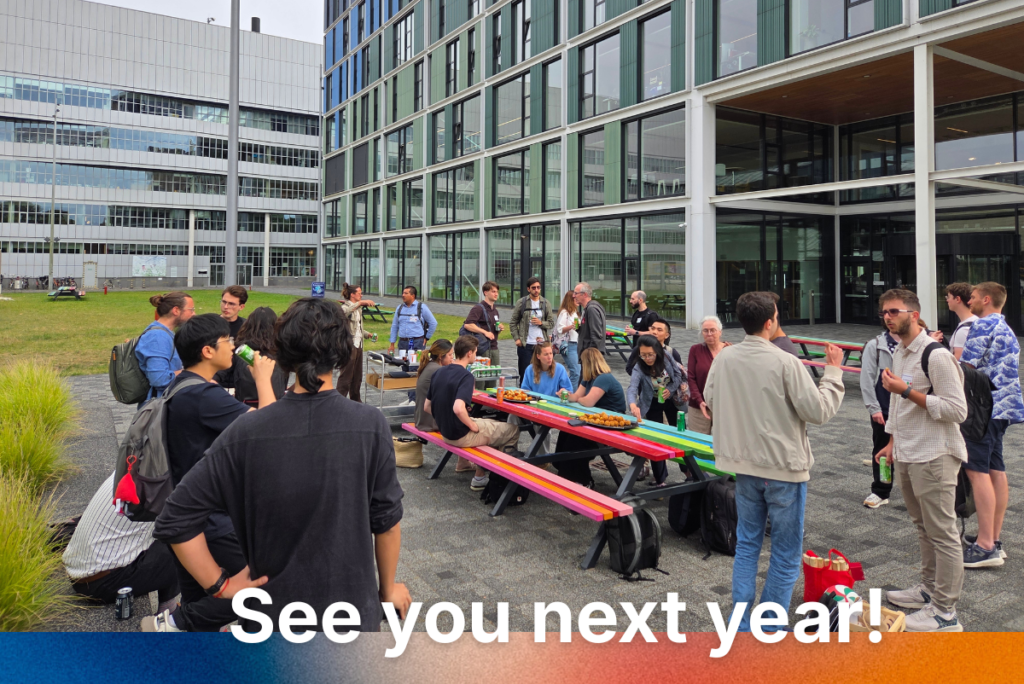
Highlights from the ICAI Summer School 2026
The ICAI Summer School just wrapped up an intense, inspiring two days of deep dives, workshops, and collaborative thinking. Bringing together leading researchers, industry pioneers, and ambitious students, the event showcased how artificial intelligence is shifting from a tool for digital pattern recognition to a fundamental pillar of scientific discovery, healthcare equity, and physical world interaction.
Here is a recap of the key themes and breakthroughs that defined this year’s summer school.
Day 1
AI for Science
The first day kicked off with an ambitious look at how AI is transforming the fundamentals of traditional scientific disciplines. Rianne van den Berg from Microsoft Research opened the lecture series by detailing the massive strides being made by the AI for Science team at Microsoft Research. Instead of looking at AI purely through the lens of text or pixels, her work leverages advanced models to tackle massive roadblocks in drug discovery, protein modeling, material design, and quantum chemistry.
Research Reproducibility in AI
As AI becomes central to scientific exploration, a vital question arises: can we trust the results? Maurits Bleeker from Emmi.ai tackled this head-on, focusing on research reproducibility in AI, specifically within the AI4Engineering domain. Bleeker reframed the current “reproducibility crisis” not as a dead-end, but as a kickstarter for better research. He shared practical blueprints to help researchers build their ideas on a reliable, verifiable groundwork.
Hybrid Intelligence: Principles for the Systematic Engineering of Human-AI Teams
Shifting the focus to how humans and AI coexist, Davide Dell’Anna from Utrecht University introduced the core mission of the Netherlands’ Hybrid Intelligence Center. Moving away from the idea of fully autonomous, isolating agents, Dell’Anna advocated for hybrid intelligence, the systematic engineering of collaborative, ethical human-AI teams. He presented concrete frameworks, such as the Quality Model for Hybrid Intelligence Teams, to help researchers systematically design and evaluate these complex sociotechnical systems.
Aurora: A Foundation Model for the Earth System
Ana Lucic from the University of Amsterdam presented Aurora, a cutting-edge, open-source foundation model for the Earth system built via public-private collaboration. Operating at a fraction of the computational cost of traditional systems, Aurora fundamentally democratizes who can afford to run high-quality atmospheric and climate predictions.
Human AI Interaction
Shifting to local impact, Bart Voorn the founder of Ditto shared a fascinating, unpolished case study of how their app Ditto helps patients remember crucial doctor consultation details. Fresh off winning the 2026 National Healthcare Innovation Award, Voorn dove straight into what breaks post-launch and the strict guidelines and rules required when building AI for people at their most vulnerable.
Neuromorphic Computing
Closing out the day’s sessions, Marcel van Gerven from Radboud University/Donders Institute brought to the audience’s attention that the human brain runs on just about 20 Watts of power. His talk on Neuromorphic Computing detailed how evolutionary computing and brain-inspired learning rules are lighting a sustainable path forward for efficient AI.
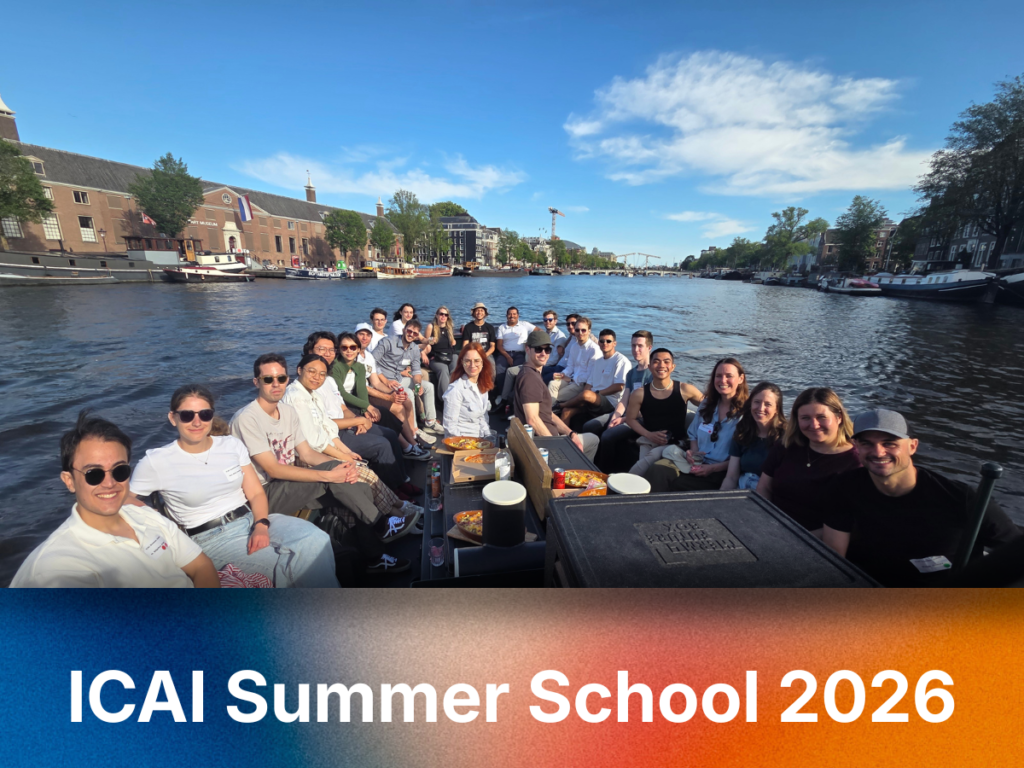
The day concluded with a transition to the Amsterdam canals, where attendees enjoyed a scenic canal cruise to unwind, discuss the day’s insights, and network.
Day 2
Day two was focused on highly interactive sessions, actionable playbooks, and the future of autonomous systems.
Agentic AI for researchers: Lessons from the healthcare frontier
Daan Geijs from Kaiko.ai opened the morning by cutting through the hype of agentic AI. Drawing from Kaiko’s high-stakes work building production systems for healthcare, Geijs mapped the evolution from basic RAG systems to modern coding agents. The highlight was a live, hands-on demo showing researchers how to safely deploy coding agents to supercharge their workflows without sacrificing accuracy.
Causal Reasoning and Statistical Tests of Fairness
Joris Mooij from the University of Amsterdam delivered a session on causal reasoning and statistical tests of fairness. Revisiting the classic Berkeley admissions dataset, Mooij used causal modeling to dissect Simpson’s paradox. His conclusion was an elegant warning to all data scientists: drawing definitive conclusions about fairness from observational data alone requires incredibly strong assumptions that rarely hold up in the real world.
Greener Code: Hands-On Energy Profiling for AI Systems
The afternoon featured a highly engaging, interactive workshop led by June Sallou from Wageningen University & Research. Attendees participated in a hackathon-style energy profiling session. Instead of just talking about sustainability, participants measured real-time consumption on an AI project playground, navigating the delicate trade-offs between system performance, model accuracy, and resource usage to write truly “greener code.”
Large Reasoning Models for Scientific Discovery
Yougang Lyu introduced EvoScientist, a framework for self-evolving AI scientists. Lyu argued that as AI takes over the execution loop of hypothesis and discovery, the human researcher’s value shifts toward high-level strategy, taste, and scientific intuition.
Cyberphysical World Models & Agents: Towards Physical & Embodied General Intelligence
As a last session, Efstratios Gavves from the University of Amsterdam presented his research program on Cyberphysical AI. Pointing out that current AI is fundamentally disconnected from physical reality, Gavves introduced frameworks utilizing world, physical, and interaction priors (such as DreMa and Morpheus). He argued that compositionality and grounding, not just throwing more data scale at a model, are the keys to unlocking safe, controllable, and truly embodied artificial general intelligence.
If the 2026 ICAI Summer School proved anything, is that the future of AI in the Netherlands and beyond is not just about building bigger models, it is about building smarter, more sustainable, more reproducible, and deeply human-centric ecosystems.
A huge thank you to all our incredible speakers and attendees for making this event a massive success! See you next year!